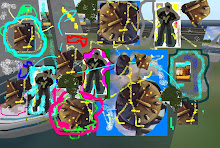
I'd like to share two reflections after my last experience with SL: first, I'm more of a blogger man, and the capability to create blogs has been the most rewarding of the many things I've learned in this course. The blogger is more individualistic and focused on writing content. Second, my current interests in ELT refer to adult, life-long learning and ESP; and I don't see how to conciliate those realities with SL's ludic interactivity.
I appreciate SL's educative potential, especially with the children of this era of technological revolution. And of course those children will grow up and there will be something beyond Web 3.0 tools for them, for playing and learning. And I especially appreciate the posibility of learning and having fun.
I'd like to share the technical problem I had, that made me waste over one hour and a half of the class: WizIq was asking me to download the latest version of Adobe Flash Player, and I tried to do it, but couldn't. There is some kind of incompatibility of that program with the navigator I use (Firefox), or maybe the Firefox version I had was faulty. At any rate, I had to go back to Internet Explorer in order to access the class. I have deleted my old Firefox and install a new version of it. I still have to find out if it works properly with WizIq and the other tools we use (I don't see why not). But anyway, it was very frustrating and when I finally entered the class, I was really tired.
Wednesday, November 18, 2009

Thursday, November 12, 2009
Conference III: Etienne Wenger on CoPs
CoPs means Communities of Practice, i. e., a group of people sharing common interests, interacting regularly, learning from each other, and seeking to improve their ability to do what they all do. There is a learning partnership between them, there is a link between knowledge and the people who know. These two cannot be separated. It is a way of living in practice and to have fun with knowledge.
The most influential teachers are those who invite you to join a community with a social discipline of learning. The SDL includes as key dimensions the Domain (negotiation on the topics that keep the group together), the Community (definition of who is a part of it and what roles are played by whom)and the Practice (shared experiences which create identity).
Technology stewards are people who understand the community's technological needs and lead technological implementation. Their first task is to understand the community in order to determine the right technology for it. Then they help the adoption and everyday use of the technology chosen.
Digital habitats are configurations of tools. Different communities need different technologies. Technologies simply help to keep them togeteher. There must be a balance between the group and the individuals. Blogs are a more individualistic sort of technology, while discussion boards and wikis are more collective. Wenger also recommends the use of open-source software.
The most influential teachers are those who invite you to join a community with a social discipline of learning. The SDL includes as key dimensions the Domain (negotiation on the topics that keep the group together), the Community (definition of who is a part of it and what roles are played by whom)and the Practice (shared experiences which create identity).
Technology stewards are people who understand the community's technological needs and lead technological implementation. Their first task is to understand the community in order to determine the right technology for it. Then they help the adoption and everyday use of the technology chosen.
Digital habitats are configurations of tools. Different communities need different technologies. Technologies simply help to keep them togeteher. There must be a balance between the group and the individuals. Blogs are a more individualistic sort of technology, while discussion boards and wikis are more collective. Wenger also recommends the use of open-source software.
Wednesday, November 11, 2009
Conference II: Nellie Deutsch and WikiEducators
Again I missed the fun of participating on-line. Nellie and Gladys Gahona introduced themselves as volunteers who want to share knowledge on-line. On-line teaching breaks the limits of the classroom. Teachers and students from different fields and countries can learn from each other.
WikiEducator is an attempt to integrate technologies for collaborative learning. It has over 11 thousand users. It is sponsored by the Open Educational Resources foundation. These resources are basically digitalized materials for teachers and students from all over the world. It uses free software and doesn't admit Windows (Bravo!).
WikiEd works as a community council, Nellie is the executive secretary. Its teaching platform is a Wiki. It has a Community Portal providing info on its activities. The contents are decided by workgroups of editors who reach consensus through discussion pages. WikiEd offers workshops, both on-line and F2F, on different subjects like blended e-learning environments, interaction, learning English on line (LEO), and the use of tools such as Moodle. Blended On-Line Learning (BOL) is what its philosphy is called.
WikiEducator is an attempt to integrate technologies for collaborative learning. It has over 11 thousand users. It is sponsored by the Open Educational Resources foundation. These resources are basically digitalized materials for teachers and students from all over the world. It uses free software and doesn't admit Windows (Bravo!).
WikiEd works as a community council, Nellie is the executive secretary. Its teaching platform is a Wiki. It has a Community Portal providing info on its activities. The contents are decided by workgroups of editors who reach consensus through discussion pages. WikiEd offers workshops, both on-line and F2F, on different subjects like blended e-learning environments, interaction, learning English on line (LEO), and the use of tools such as Moodle. Blended On-Line Learning (BOL) is what its philosphy is called.
Conference I: George Siemens on Connectedness
I could not attend this class live, but I checked the recording. In the beginning, as usual, there were technical adjustments. The work done today is pioneering, I'm sure in 5 years these technical flaws will be overcome.
The conference is on connectivism and social networking. 15 minutes passed before the speaker could start. There were complaints about the audio, Siemens himself commented that perhaps video interfered with audio.
The idea of connectedness implies global, lifelong learning. Being connected seems to be part of being human nowadays. Connectivity is an issue with the military, whose Future Combat Systems depend on it. We see everywhere large-scale, centralized systems being replaced by small, loosely connected elements. Being connected has become a social need. Not knowing might be catastrophic in many ways.
The old paradgims are being shattered. One of them, the experts, who are becoming increasingly ineffectual, and are losing their influence. The information flood forces us to try to make sense out of it. It is a matter of quantity vs. quality. More is diverse, and this brings down many myths. Today we wonder whether classrooms or offices are really indispensable. Participation now can be physical or virtual. Social, informational networks replace experts. Teaching in a networked world demands revising all former ideologies.
The conference is on connectivism and social networking. 15 minutes passed before the speaker could start. There were complaints about the audio, Siemens himself commented that perhaps video interfered with audio.
The idea of connectedness implies global, lifelong learning. Being connected seems to be part of being human nowadays. Connectivity is an issue with the military, whose Future Combat Systems depend on it. We see everywhere large-scale, centralized systems being replaced by small, loosely connected elements. Being connected has become a social need. Not knowing might be catastrophic in many ways.
The old paradgims are being shattered. One of them, the experts, who are becoming increasingly ineffectual, and are losing their influence. The information flood forces us to try to make sense out of it. It is a matter of quantity vs. quality. More is diverse, and this brings down many myths. Today we wonder whether classrooms or offices are really indispensable. Participation now can be physical or virtual. Social, informational networks replace experts. Teaching in a networked world demands revising all former ideologies.
My assessment of the course so far
It has been an enriching experience. I feel like a different person (and I'm not just saying it). Evelyn has been a facilitator in the best sense of the word. She has shown us a new way to be a teacher. I see now that, although I thought I was a fairly good user of computers, I was 20 years behind. I lacked fluency with the new possibilities of connectivity. The blog is actually what I had been looking for for years. It's the best way to create your own magazine, and keep it going for free.
With the new knowledge gained, I designed a blog in the university I work at (UCSAR) and another one for my Greek class. Since that is a small class and the people at least have their own computers, I could try interactive teaching with them.
My English classes, as you know, are for people the majority of whom neither own computers nor have access to technology in general. It is a shame, because I have also learned the limtiations of technology. There's a long way to go before society in general can profit from the technological revolution.
With the new knowledge gained, I designed a blog in the university I work at (UCSAR) and another one for my Greek class. Since that is a small class and the people at least have their own computers, I could try interactive teaching with them.
My English classes, as you know, are for people the majority of whom neither own computers nor have access to technology in general. It is a shame, because I have also learned the limtiations of technology. There's a long way to go before society in general can profit from the technological revolution.
Thursday, November 5, 2009

Subscribe to:
Posts (Atom)